I can hardly believe it's nearly already a month since facilitating #PYB19 for Maternal Mental Health Awareness in our local community in Bray. Already the wheels are turning in my head for the next Community Doulas Community event...


Community Doulas were thrilled to be facilitating a #PYB2019 Paint Your Bump for Maternal Mental Health event. As one of the co-ordinators of the event I facilitated the conversation in the room around all things Matresence: The Birth of The Mother, alongside discussing the expectations of becoming a mother, or father, or granny, with the participants, the grief and struggles people have faced in becoming a family and talked with the group about optimising rest and recovery once their baba arrives into their world. Quiet seriously, I was blown away by the honesty and open hearts that were brought to the room last Wednesday evening, the women, the mom's, the mom's to be, the dad's, the granny to be, the kids. Every single person completely and totally put their hearts and minds into the space created with the intention of open and honest conversation.

The role of #PYB19 was to have an safe fun environment where we could share our thoughts and offer the opportunity to the participants to thinking about their self care whilst highlighting maternal mental health in both the remainder of their pregnancy and their Postpartum. Available on the evening for conversation alongside Community Doulas, was the team behind Hippy + Bloom taking photographs, Ali from Craftea Parties, Laura from Quaint Baby Art and Aoife from Ahimsa Yoga Ireland.
According to Maternal Mental Health Alliance 2014, Perinatal Mental Health refers to a woman's mental health during pregnancy and the first year after birth. This includes mental illness existing before pregnancy, as well as illness that develop for the first time, or are greatly exacerbated in the perinatal period.
It is thought that approximately 1 in 5 of us will experience perinatal mental health issues. Think about that number in context the next time you're in a room full of people. It is not uncommon. Why then, is it something that can be so difficult to talk about, to discuss, to share about? And what might it mean? Perinatal mental health issues include:

- Perinatal anxiety
- Perinatal depression
- Obessive Compulsive Disorder (OCD)
- Post Traumatic Stress Disorder (PTSD)
- Psychosis.
Specialist Perinatal Mental Health Services. Model of Care for Ireland. HSE Mental Care Services.2017
When I go into a family antenatally to discuss what their support might look like for them when their baba arrives earth-side, this is a critical part of the conversation. In my role as a postpartum doula if I can educate and inform antenatally to these numbers, and if the family's I support know that the numbers translate into so many of us experiencing some level of perinatal mood disorder and it doesn't show up for them, deadly. By me addressing this hugely important topic with them, I am hopefully helping break down the barriers to silencing this conversation should it arise at any point, for either parent. It would be remiss of me in my role not to discuss perinatal mood disorder, and at the very least if we know what our own particular range of normal looks like, we can be more able to understand where, when, or if we are straying off this range.
The Postpartum Plan is another critical part of my conversation piece at my initial consult with a family. How many of us think about the pregnancy, and the birth, read all the books, the blogs, the emails and don't think to go any further? So many of us. Your Postpartum Plan for some families is nearly a conversation starter. If we haven't discussed something, how do we know that it or what is important to another person. Your Postpartum Plan asks you to think about what your priorities might be, alongside other aspects of your life, once your baba arrives. It allows a conversation between the caregivers, to think about and discuss what contributes to your positive mental health in your daily and weekly life. In reality Your Postpartum Plan asks what self care might look like for each of the new parents, and how you can weave these into your lives.
As I said above, weaving self care into our everyday lives is part of the remit of #PYB. Self care does not need to be formulated into some elaborate task, or scheduled; self care is something you do, everyday, something simple. Self care is about looking after you, for you!

Over on the Community Doulas page I post about self care under Slow-Down-Sunday. Slow-Down-Sunday is a reminder! Slow-Down-Sunday is about finding a space in our day, everyday for ourselves. Slow-Down-Sunday is about finding something simple to look after and mind ourselves today.
The #PYB event was about facilitating these moments, shared experiences over a cuppa in a safe warm environment. Here's what our a few of the amazing participants had to say about their experience at Bray #PYB19.

Kate came along to our event with her gorgeous son big-brother-to-be Jack


All this beautiful conversation and time for ourselves was then reinforced. We had Aoife lead the room in her most beautiful Yoga Nidra bringing us connection, stillness and space for our bodies. Aoife encouraged us to remember the feeling of weight in our bodies and to remember the sense of calm that brings us.
Belly breathe is a wonderful tool, which is free and accessible to all of us. Again, finding a space in your day to breath deeply can be of huge benefit to so many of us. Breathing again does not need a 35 minute daily practice; you can do it whilst your waiting for the kettle to boil, or before you get out of the car on collection for the school run.

Aoife guided us to try and reconnect with the feeling of weight in our quiet bodies and asked us all to try and find a way to emulate that ourselves. Belly breathing for relaxation can be as simple as inhale through your nose for 4 seconds, hold that breath for 7 seconds, and exhale for 8 seconds.

When we have conversations with each other, when we talk in the realities of new motherhood, we share something special. In holding space for someone to have open and honest conversations with eachother, with a postpartum doula, we are creating a safe non-judgemental environment in which we can explore how we are feeling as new parents.
My newest library book addition is Good Moms Have Scary Thoughts written by Karen Kleiman and illustrated by Molly McIntyre. You may have already seen a number of these amazing images going around the internet. Wouldn't it be amazing if we actually shared with eachother our thoughts, rather than responded with what we think people want to hear, or what we think they want us to say?
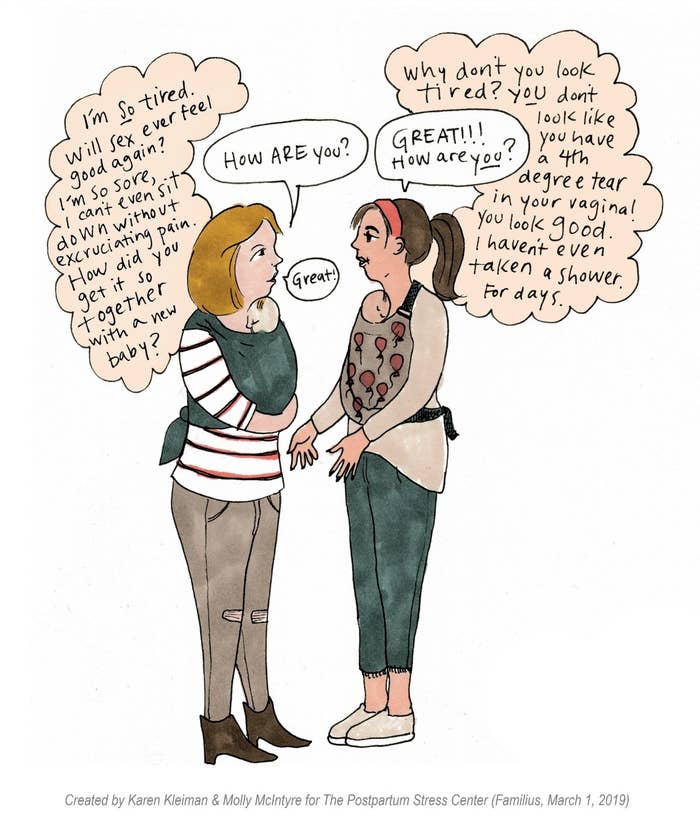


You'll often hear me say that some of the most important work I do is exploring our thoughts and conversations at the bedside over a cuppa with the new family. By putting our hands up and showing our vulnerability there is an amazing ripple out effect. In doing this we show others that we might need help, and that it's ok for them to ask for help from us.
The conversation around mental health has opened up and changed in the past five or so years. The hashtag #itsoktonotbeok and all the work behind it has made significant inroads in opening up the conversation around mental health awareness and around destigmatising mental health illness. If you are concerned about any of the topics raised within this piece please do get in touch with your health care provider to discuss avenues of support.
The conversation around mental health has opened up and changed in the past five or so years. The hashtag #itsoktonotbeok and all the work behind it has made significant inroads in opening up the conversation around mental health awareness and around destigmatising mental health illness. If you are concerned about any of the topics raised within this piece please do get in touch with your health care provider to discuss avenues of support.

Charlie Mackesy IG
Alternative if you would like to me to hold space for you please do get in touch. You can call me on 086 0438642 or email me sandy@communitydoulas.ie
Be well, Sandy x
There are a number of support organisations and helplines available who can help with maternal mental health issues: their contact details are below.
- Postnatal Depression Ireland www.pnd.ie 021 4922083 support@pnd.ie
- Samaratans 24 hour helpline phone 116123 www.samaritans.org
- St Patrick’s Mental Health Services' Support and Information Line phone 01 2493333 www.stpatricks.ie/
- Parentline www.parentline.ie/ phone 1890 927277 or 07 8733500
- Aware www.aware.ie/ phone 1800 804848 Mon - Sun 10am - 10pm
- Cuidiú Cuidiú Parent to Parent Support www.cuidiuparenthood@gmail.com
- Nurture Health phone www.nurturehealth.ie 086 8619585 info@nurturehealth.ie
- Women's Aid phone 24 hours a day, 7 days a week 18003419000 www.womensaid.ie helpline@womensaid.ie
- Bray Women's Refuge phone 01 2866163


No comments:
Post a Comment